I want to address something head-on that I see come up again and again online—especially in children’s book spaces: the controversy around authors using AI to assist with illustrations.
Before I ever joined an online group for children’s book authors, I had already published three books. Once I did join a Facebook group for authors, I quickly realized it wasn’t a place where I felt comfortable sharing my work. There was a strong—and often harsh—stance against any use of AI in the creative process. I knew immediately that if I posted anything, I’d be opening myself up to criticism. So I quietly left.
I understand where some of that frustration comes from. I truly do. Illustration is a skill, a craft, and a livelihood. Many illustrators have spent years developing their style and deserve to be valued and paid fairly for their work.
But here’s my side of the story—the part that often gets lost in online debates.
When I wrote my first book, I had a poem, but no plan to publish it publicly. It was created for my granddaughter, simply as something special from me to her. I can’t draw, and I had no budget for an illustrator. I also wasn’t trying to sell the book. So I used Canva.
At the time, I wasn’t concerned about perfect cohesion in textures or colors. I enjoyed finding images that represented what I wanted to say. I tucked in inside jokes and little Easter eggs for my family. It was joyful and personal—and that mattered more to me than polish.
Then Socks on a Walk came to be.
This time, I knew exactly how I wanted the book to feel visually—but again, hiring an illustrator simply wasn’t financially possible. Most of my books are for ages 2–8, which means illustrations on nearly every page. That’s 24–36 illustrations per book. Paying a professional for that many pages would be a beautiful investment—but it would also be far beyond what my family could afford.
So I started experimenting.
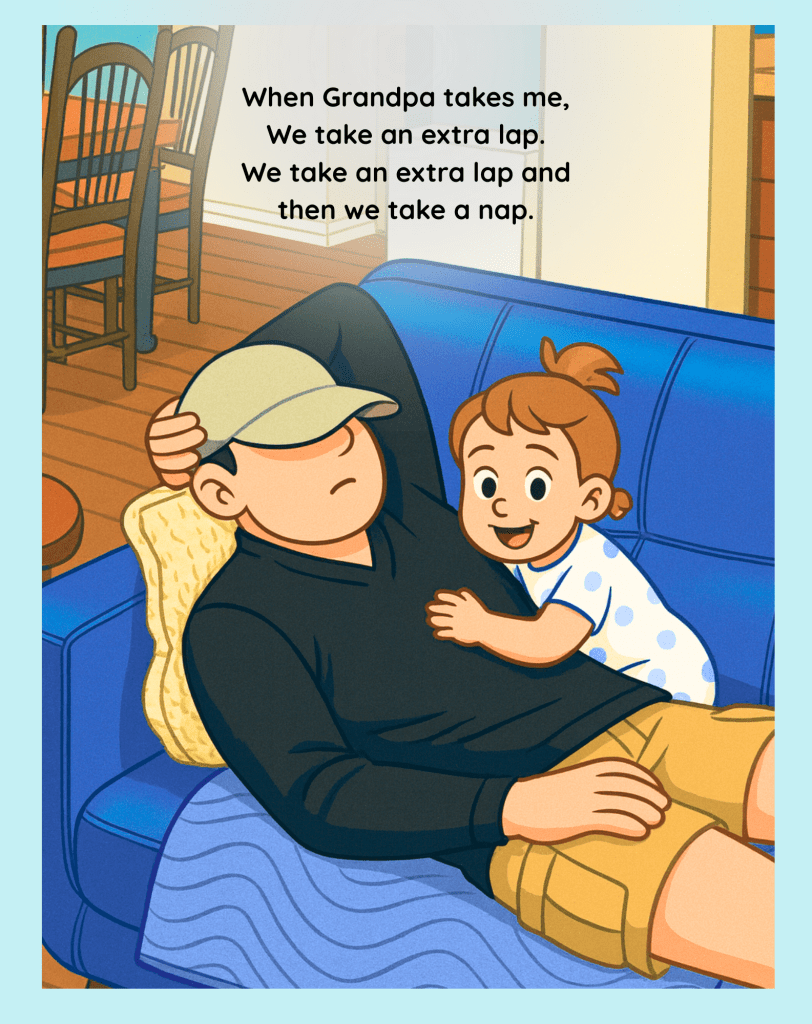
I discovered that if I took a photo and asked AI to transform it into a cartoon-style image, I could get results that were surprisingly close to what I imagined—sometimes almost too accurate. From there, I brought those images into Canva and began refining them using tools like Magic Grab, Magic Erase, background removal, and layering. Many of those tools, too, are AI-powered.

Over time, I learned. A lot.
I learned about consistency, color rules, texture, and style. I learned how to refine images instead of just generating them. I learned how to build characters that felt cohesive across pages. And I learned that digital illustration—like any medium—still requires time, decision-making, and creative intention.
That’s how the illustrations for Socks on a Walk evolved. And it’s how I continue to create today.
Do I hope that one day I might earn enough from my books to hire a professional illustrator? Absolutely. I would love that. But for now, I’m choosing to refine my skills with the tools I do have access to.
Some people may disagree with that choice. Some may even boycott my books because of it. I can’t control that.
What I can do is be honest about my process and my intentions.
So now you know my “why.”
 Boys will be Joys
Leave a comment